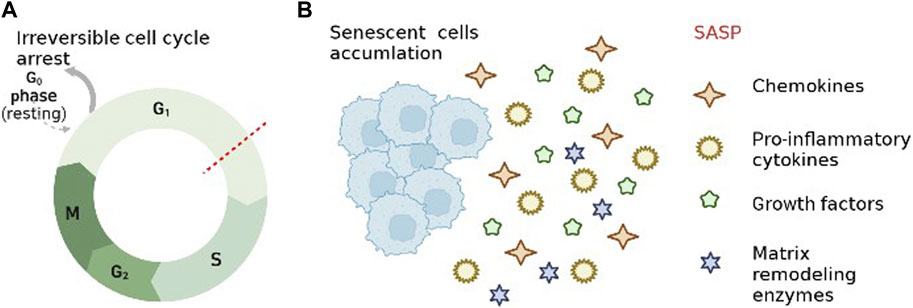
The molecular architecture of cell cycle arrest Biology Diagrams Abstract. Background: Cellular senescence is a state of irreversible cell cycle arrest that serves as a critical regulator of tissue homeostasis, aging, and disease.While transient senescence contributes to development, wound healing, and tumor suppression, chronic senescence drives inflammation, tissue dysfunction, and age-related pathologies, including cataracts. (D-G) Transcriptional expression of cell cycle arrest markers (p16 INK4a, p21 WAF1) and SASP factors (IL-6, IL-1b) within the hippocampus of vehicle-treated cognitively stratified and senolytic-treated aged male mice. (H, I) Quantification and representative images of senescence-associated beta-galactosidase staining within the hippocampus.

Cellular senescence is a tumour suppressor programme characterized by a stable cell cycle arrest. Here we report that cellular senescence triggered by a variety of stimuli leads to diminished Loss of SIRT1 activity is associated with multiple aspects of senescence, including SASP activation 91 and cell cycle arrest 92, as well as several senescence-associated degenerative pathologies Cellular senescence is a major driver of age-related diseases, and senotherapies are being tested in clinical trials. Despite its popularity, cellular senescence is weakly defined and is frequently referred to as irreversible cell-cycle arrest. In this article we hypothesize that cellular senescence is a phenotype that results from the coordination of two processes: cell expansion and cell
Cellular senescence: Current Biology Biology Diagrams
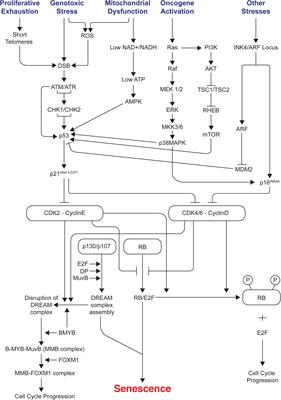
The senescence-associated irreversible cell-cycle arrest is mainly characterised by the activation of two cyclin-dependent kinase inhibitors, p21 WAF1/Cip1 (p21) and p16 INK4a (p16), which halt cell-cycle progression in G0/G1 phase. Although extensively used as a senescence biomarker, activation of a state of irreversible growth arrest is These changes have been linked to both the cell-autonomous and paracrine aspects (that is, the effect on surrounding cells) of senescence-associated proliferation arrest. Senescence-associated Cellular senescence is a stable cell cycle arrest that can be triggered in normal cells in response to various intrinsic and extrinsic stimuli, as well as developmental signals. Mechanisms of Cellular Senescence: Cell Cycle Arrest and Senescence Associated Secretory Phenotype Front Cell Dev Biol. 2021 Mar 29:9:645593. doi: 10.3389/fcell